
Work in progress
Bad news
I flew back from Philadelphia at the end of May 1975, leaving behind half the things I’d gathered over the past two and a half years. There wasn’t really time to pack properly: my father had called, extremely worried about my mother’s health, and the overall tone was grim enough for me to book the next flight home without hesitation.
When I landed at Charles de Gaulle, still foggy from the overnight flight, I was immediately intercepted by customs officers who wanted to know where exactly I had been hiding for the past three years. The reason, of course, was the glorious institution known as National Service, which every French male had to comply with at the time. At eighteen you had to register and then endure the so-called “three days” of assessments in Blois.
To be fair, I had actually done my part: the French Consulate in New York had summoned me the year before, and I’d dutifully visited an accredited doctor there. That was supposed to count as my “three days.” But apparently this little administrative detail had not found its way into the files at the airport. They finally let me into the country with a charming “You’ll hear from us very soon.” And indeed, I did.
A couple of weeks later, I received a letter — the kind you absolutely cannot ignore — ordering me to present myself in Blois for the official three days. I cannot recommend the experience. Between the humiliating physical tests, the bizarre aptitude evaluations, and the interviews that tried to determine whether you were fit to defend France or just fit to peel potatoes, it wasn’t exactly a delightful stay. At the end you were labelled either “fit for service” or not. Many people pretended to have mysterious ailments, some even had medical certificates crafted with great imagination, and a few were indeed declared unfit. I didn’t dare try.
Then came the question: Army, Navy, or Air Force? I immediately chose the Air Force, hoping to be stationed in Toulon. Not only would the weather be glorious, but I could easily slip away to Marseille to visit family, or to Cavalaire where my parents had an apartment. A perfectly reasonable plan, I thought.
I returned to Paris from Blois with the enthusiasm of a man heading to the gallows: I had been told I would be drafted in the coming weeks. Fortunately, my mother made a sudden, almost miraculous recovery, and it was decided we would go down to the south of France for a holiday. My fiancée Carole joined us from England, and we enjoyed the beach, the bars, and the usual crowd of summer friends.
Then came the unforgettable day.
One sunny lunchtime, we were sitting, as usual, at the Galiote bar, enjoying a few glasses of pastis, when my mother walked in holding an envelope. Not just any envelope — THE dreaded letter from the Ministry of Defence.
With trembling hands, I opened it… and I will never forget the shock. I was expected to report not to Toulon, as I had so hopefully imagined, but to Annecy as a Chasseur Alpin — an Alpine hunter, a mountain soldier. Me! Marching through the snow with skis and a rifle like some kind of military ibex. The very idea was enough to freeze my blood faster than a February blizzard in the Alps.
I’m still not entirely sure how I survived that day. The only word that comes to mind is: nightmare.
➿➿➿
The first few days
As far as I can remember — which, admittedly, is not very far at all — we stayed in the south of France for another couple of weeks. My memory of the return to Paris is a foggy blank, as if someone had pressed the “skip chapter” button on my life. I don’t recall the long drive north, nor Carole flying back to England. What I do remember, in a vague, dreamlike way, is being on the overnight train from the Gare de Lyon to Annecy, lulled into a half-sleep by the rhythmic clatter of the tracks and the creeping dread of what awaited me.
At Annecy station, a row of army trucks greeted us with all the warmth of a tax audit. They filled rapidly with long-haired young men who looked, in most cases, as if they had been scooped off the streets at random — bewildered, slightly terrified, and already nostalgic for their civilian freedoms. Having lived abroad and travelled a bit, I fancied myself reasonably worldly. I certainly didn’t feel homesick; more “mildly curious with a side of apprehension.”
The barracks were only ten minutes away, a modern complex on the outskirts of town that possessed all the charm of a refrigerated warehouse. As in every army film ever made, we were ordered off the trucks and lined up in a vaguely straight formation, our bags dumped unceremoniously at our feet. Commands were barked at us with admirable enthusiasm. We learned that we were now officially known as “la huit 2025” — the august group of August 1975 — and that we would be divided into three-and-a-bit sections. This sounded impressively organised, at least until they started shouting more instructions at us.
We were told where to collect our uniforms (generously described as “clothes”), where our rooms were located, and which sergeants would be responsible for our general misery. Each section contained four pelotons, or combat units. I discovered I had been assigned to Section 2, Company 2 — a combat section. Some lucky souls were sent to the motor pool, or medical services, or even the canteen. I, apparently, was destined for the thrilling world of military exertion.
Over the next couple of days, we were treated to several unpleasant rites of passage. First came the haircut, which in my case made little difference since my hair was already short. Then came the infirmary — a deeply humiliating conveyor belt of injections, examinations, and being prodded in ways that would make your average farm animal object. There is nothing uplifting about having a painfully shy young doctor cup your testicles while instructing you to cough in front of an audience. The less said about the mandatory foreskin inspection, the better.
We were then instructed in the great mysteries of army life: how to dress correctly, how to arrange your meagre belongings in the allotted cupboard, how to make a bed with the precision of a Swiss watchmaker, and other essential skills without which civilisation would clearly collapse.
One curious detail: the standard-issue boots were made of pristine brown leather. One of our earliest assignments was to transform them into glossy black footwear using army polish. This process took roughly forever and involved an alarming amount of elbow grease. Anyone who thinks this is easy has clearly never served in the Alpine troops.
The first few nights were a strange combination of discovery, boredom, and cautiously getting to know the seven other men in my room. About 95 percent of the draftees were local boys — farmers, ski-resort workers, or both, depending on the season. Many were semi-literate, which surprised me, as did the fact that, apart from me, most seemed to have volunteered for this adventure. To this day I have no idea why I was sent here instead of the Air Force posting I had so sensibly requested.
Soon enough, we were interviewed about discipline, leave rules, and where exactly home was. When asked for my address, I cheerfully answered “Philadelphia,” which was indeed the last place I’d lived. This did not go down well. To smooth things over, I admitted (creatively) that I had family in London — which was, of course, untrue, but Carole lived there so it felt close enough. This satisfied them. The key point was that we were entitled to free train tickets home for leave, and since all trains to London passed through Paris, it meant I could simply hop off at La Celle Saint-Cloud to see my parents. A neat arrangement, if I say so myself.
And so the first week passed. We learned our way around, established who we could tolerate and who we intended to avoid for the rest of our natural lives, and were proudly informed that we would be allowed our first weekend leave in two months — once we had completed our intensive basic training.
And just like that, army life had begun.
➿➿➿
The art of surviving blue bérets and early morning runs
Intensive training begins with all the charm of a cold shower: unavoidable, shocking, and guaranteed to wake you up whether you want it or not. The programme is a sophisticated blend of classroom theory—just enough to prove that someone, somewhere, once read a manual—and vigorous athletic torture. The latter usually kicks off before the sun has decided whether it wants to rise. At the delightful hour of dawn, we are herded out for a one-hour run.
Running and I have never been close friends. At best, we have an agreement: I don’t bother it, and it doesn’t bother me. Unfortunately, the Alpine Troops have little respect for such pacts. So off we go, panting through fields and forests while the truly athletic ones pretend this is perfectly normal human behaviour.
Next comes the noble art of marching in unison. You would imagine that a group of able-bodied young men could master the simple task of putting one foot in front of the other at the same time. You would be wrong. Some march like they’re auditioning for a musical, others like they’re trudging through wet cement. Yet, after enough shouting, shuffling, and questionable footwork, we begin to resemble a coordinated unit. Or at least a well-meaning approximation.
Parade uniforms are issued during this period—both winter and summer versions. Each includes the Alpine Troops’ most famous fashion statement: an enormous blue béret roughly the size of a family-sized pizza. Distinctive? Absolutely. Practical? Questionable. Flattering? Let’s say it’s a conversation starter.
Towards the end of the two months comes our first bivouac. Nothing too heroic: a modest ten-kilometre march, pitching tents, and back the next day. Nevertheless, for those of us carrying a fully packed rucksack for the first time, the experience is… educational. The straps dig in, the pack grows heavier with every step, and you begin to suspect that someone filled it with rocks as a joke. I confess: the going got tough for several of us, myself included.
But salvation approaches: our first 72-hour leave. And it happens to be the end of August. Freedom, the sea, civilisation! I decide to take the train down to the coast and head to Cavalaire, where my parents should be. There’s just one condition: we must travel in full uniform.
To our surprise, the uniform turns out to be a blessing. People are friendly, hitchhiking becomes effortless, and conversations spark naturally as soon as someone recognises the unmistakable “Chasseur Alpin.” The béret does most of the talking.
When I reach Cavalaire and meet my parents, my mother reacts as though a national hero has returned from a perilous expedition. I am treated like royalty for the next couple of days—days I spend largely on the beach or at the very bar where I received my marching orders barely three months earlier.
Sun, sand, and civilian life: a perfect reminder that even soldiers need a holiday now and then.
➿➿➿
Marching into autumn with capes, skis and martian fashion
Returning from leave, we barely have time to dust the sand off our boots before being ordered to pack everything once again. Our training base, it turns out, was merely temporary. We are moved into our new permanent barracks—much older, much more central, and full of that unmistakable military charm: peeling paint, creaky floors, and pipes that clank in the night like ghosts practising percussion.
But we are now with the real troops, no longer the fresh-faced recruits of two months prior. And the Army proves it by issuing us two new items: guns and skis. Yes, skis. At the same time. A combination that makes you wonder whether someone in logistics was having a laugh.
Weapon training begins immediately. Not the glamorous action-movie version—no heroic poses or clever one-liners. Instead, we learn to take the rifle apart, clean it, oil it, and, crucially, reassemble it without losing any pieces. We must also perform this delicate surgery in the dark or with our eyes closed. Miraculously, we all manage it, though a few rifles do briefly resemble modern sculptures along the way.
Morning runs are still compulsory. Turning left out of the barracks takes us directly to Lake Annecy—a stunning view that would be perfect for peaceful reflection. Naturally, we are not allowed to stop, admire it, or even breathe too loudly in its presence. We just run past it like condemned men passing a pastry shop.
Evenings bring respite for those not on guard duty. We are allowed out, and—luxury of luxuries—we do not have to wear our uniforms. Not that it matters: our identical haircuts announce our unit membership louder than any insignia. Still, it feels like freedom, and we embrace it with the enthusiasm of sailors spotting the shore.
Autumn sweeps into the Alps quickly, bringing crisp air and the first real outings. Trucks shuttle us to the base of nearby mountains, where we march up, pitch tents, and stay for a couple of days. There we practise vital skills such as camouflage, which mostly involves rolling around in mud and hoping no one laughs. By Friday, we are back at the barracks with the sacred weekend ritual: cleaning everything. Equipment polished, boots shined, rooms tidied. Being a combat section, we enjoyed certain… indulgences. As long as things looked reasonably tidy, our superiors remained mercifully silent. Rumour has it that other sections were not as fortunate.
After one month, the second leave arrives—48 hours this time. A blessing for the locals, who are home within minutes. For those of us from the Paris region, the journey is more of a pilgrimage. A handful of us gather at the Annecy train station to catch the overnight train to Gare de Lyon. From there, I switch to the underground to reach Gare Saint-Lazare, then board the 30-minute train to Vaucresson, followed by the nearly two-kilometre uphill trek to my parents’ home in La Celle Saint-Cloud.
And of course, all of this must be done in full winter uniform.
Picture it: dark blue jacket, dark blue trousers rolled army-style to just under the knees, thick white wool socks, heavy leather ski boots, a long dark blue cape (excellent as a blanket on trains), and the pièce de résistance—the giant blue “pizza béret.” While the uniform is well known in the Alps, in Paris it might as well belong to a visiting extraterrestrial delegation. People stare openly, as though waiting for me to announce intergalactic peace negotiations.
Arriving home, I ring the bell. My mother opens the door, takes one look at me in full Alpine glory, and all but swoons from pride. I spend the necessary amount of time being properly adored before making a swift exit toward our usual meeting place at Élysée II. With no mobile phones or texting, I simply hope someone will be there. And they are.
The next 36 hours vanish at alarming speed—friends, stories, laughter, a brief return to civilian life. Then comes the Sunday night train back to Annecy, arriving just in time for the solemn Monday “Levée du Drapeau.”
Thus concludes another chapter in the glamorous life of a Chasseur Alpin—half soldier, half mountaineer, and full-time curiosity to the citizens of Paris.
➿➿➿
The next two months
The following weeks shifted from “mildly military” to “full army mode” faster than you can say about-face. Shooting practice kicked off in earnest. Each morning, we were loaded into trucks and shuttled several kilometres out of town to the shooting range — the army’s equivalent of a daily commute, except with more mud and fewer coffee breaks.
I’d been issued a rifle and directed to the targets lined up neatly at 200, 400, 600 and, for the romantically optimistic, 800 metres. We novices were stationed at the 200-metre line, presumably to avoid taking out a cow or a tractor by mistake. I wasn’t half bad, probably thanks to some long-forgotten encounter with a firearm in my youth. Somehow — don’t ask me how, memory has mysteriously declined — the instructor summoned three of us after a few weeks and asked if we’d like to volunteer for marksman training. It took us two days of debate (balancing visions of glory against the likelihood of self-inflicted embarrassment), but in the end we bravely said yes.
First upgrade: new rifles. Proper ones. We were handed the venerable FRF1 complete with optical sights. As aspiring sharpshooters, we were expected to function independently — loosely translated as being sent off up hills on our own so the rest of the section didn’t have to listen to us fussing over our scopes. Training started with the essentials: learn the rifle, learn the scope, and most crucially, learn to breathe without wobbling like a jelly.
Then came the part that felt almost scientific: adjusting the rifle to our personal build. We added rubber pads to the side of the butt so it rested lovingly against the cheek, and another at the back to fine-tune the length. The mission: make sure that every single time we picked up the rifle, it felt like déjà vu in wood and metal.
Only then were we entrusted with ammunition. We began at the 20-metre range, calibrating the scope in painstaking five-shot batches. Lie down. Fire. Inspect. Draw a circle. Measure the distance from the centre. Fiddle with the vertical wheel. Fiddle with the horizontal wheel. Repeat. And repeat. And repeat again until we no longer felt our elbows.
At some point — after more rounds than I care to count — the trainer announced we were ready for the big leagues. We moved to 400 metres, then gradually to 600 and finally the fabled 800. By the end, we could reliably hit a packet of cigarettes eight times out of ten at that distance. Fortunately, our combat rations each contained a pack — the army’s way of ensuring we never ran out of targets. They also included a miniature bottle of cognac, allegedly to calm the nerves. Whether that improved marksmanship or just morale remains a matter for philosophers.
Indoor training with the humble .22 long rifle provided comic relief. Our instructor loved theatrics. His favourite stunt involved balancing an axe upright, placing two tin cans on either side, and firing at the blade. The bullet would split neatly in two, hitting both cans. Very impressive — and, to my astonishment, something I managed to accomplish once.
One afternoon, while we were at the 800-metre line adjusting for winds strong enough to shove a bullet half a metre sideways, we spotted movement another hundred metres beyond the target. A wild boar. With our scopes, it was unmistakable. We exchanged looks. Should we? It would have been ridiculously easy. But then what? Drag a 100-kilo boar back to camp and file the world’s least convincing incident report? We wisely returned to shooting inanimate objects.
Eventually, all our scores were tallied, and we were told we’d passed. We received our certificates — the esteemed Tireur d’Élite — and a golden insignia of two crossed rifles to pin proudly to our uniforms.
And just like that, our life as marksmen within a combat section officially began.
➿➿➿
Le chalet
Some 90 kilometres east of Annecy—far enough to feel remote, but not quite far enough to escape military logic—lies the ski station of Flaine. A couple of kilometres before reaching it, the so-called chalet du 27BCA (Bataillon de Chasseurs Alpins) stands proudly in the middle of absolute nowhere, as if posing for a postcard no one asked for. The building is fairly modern, surprisingly comfortable, and built to house roughly 120 soldiers, give or take a few lost souls. It was our base for mountain training, our home among the peaks, and the birthplace of many questionable decisions.
First came the BAM (Brevet Alpiniste Militaire). This began with a “fast walk” up a mountain—because apparently calling it a hike would have been too kind. If memory serves me correctly (and sometimes it prefers not to), the elevation gain was 1,500 meters, to be conquered in under three hours. After that warm-up, we were taught to climb a rock face and—more surprisingly—to come back down again. Abseiling, they called it. “Stepping backwards off a cliff with only a rope and blind faith,” we called it. It takes a certain amount of courage to let yourself tip over the edge the first time… and possibly the second as well.
There were knots to learn, techniques to master, and a variety of ways to embarrass oneself in front of one’s fellow soldiers. But after a few weeks we earned our certificates—and, far more importantly, the shiny metal badge to pin proudly next to our newly acquired sharpshooter one. Our uniforms were beginning to resemble modest Christmas trees.
Then came the BSM (Brevet de Skieur Militaire). By November the first snow had powdered the mountains, and once again we were sent to Flaine for “exercises”. Upon arrival, the instructors asked the fateful question:
“Who cannot ski?”
Without missing a beat, the handful of non-locals raised their hands. They were my roommates, mostly Parisians—so nothing suspicious there. Except for one tiny detail: we were all excellent skiers. Thanks to farsighted parents, we had been put on skis practically in infancy, long before we could walk without wobbling.
But as far as the army was concerned, we were total beginners. Perfect.
We were assigned a teacher, a truck, and orders to remain at the chalet for at least two weeks to “learn to ski, the army way.” Meanwhile, the rest of the troops were shipped back to Annecy to do… whatever non-skiers do.
Those two to three weeks were, without question, the very best of our entire military service.
Each morning the truck ferried us to the village centre and the ski lifts. The lifts were free for us—still are, by the way—because we were the army’s “reluctant volunteers” to test the installations before the season opened. More about that in another chapter. We were also designated first responders in case of an accident or avalanche, among other glamorous responsibilities.
With my military ID, I still benefit from a lifelong free pass in the resort—and possibly a couple of neighbouring ones. A perk worth every icy morning.
The Arpège skis were excellent; the old-school lace-up boots were… character-building. But we devoured the slopes at full speed, every day, all day, for three glorious weeks. Evenings at the chalet were spent making “intensive use” of the bar—no sergeant, no officer, no killjoy in sight. Simply wonderful.
➿➿➿
Igloos, pee-cicles and other winter joys
Skiing downhill? Easy. We could do it on the slopes, off the slopes, and probably in our sleep if given half a chance. But army skiing is a different beast entirely. In the military, before you glide heroically downhill, you must first trudge tragically uphill—and not with the help of a civilised ski lift. No, no. You go up on foot. Because of course you do.
The method is simple in theory: strap some skins under your skis, loosen the bindings so your heels can lift, and start walking like an enthusiastic duck. The hairs on the skins—synthetic nowadays but once walrus (naturally, because nothing says “practical winter equipment” like a marine mammal)—let you slide forward but keep you from sliding backwards. So far, so good.
Except there’s a trick: you must maintain an odd, slightly humiliating posture for the skins to work properly. Now add a 25–30 kg rucksack with a rifle strapped on top, wobbling like an uninvited guest at a wedding. Balance becomes a spiritual concept rather than a physical one. We spent days climbing mountains, not remotely looking forward to the descent. By the time you reached the summit, your legs were jelly and your back felt like it had been personally targeted by gravity.
When we trained in Flaine, holidaymakers floated past us on ski lifts—the very same ones we had tested for safety just weeks earlier—pointing at us as we struggled up the slope like exhausted penguins. Not the most flattering moment of my military career. My physical condition wasn’t glorious back then, so I was often the last one. Fortunately, teamwork is drilled into you; they always waited for me. Saints, the lot of them.
Eventually, though, we became a functioning section. We learned how to transform skis, poles and a couple of ponchos into a surprisingly effective snow stretcher and evacuate a pretend casualty downhill without losing either the patient or the stretcher. Finally, we were ready for the BSM, which, much like the BAM, involved a long uphill slog with skins, full kit, and a stopwatch ticking ominously. But we made it—all of us—and earned the certificate and medal to pin next to the BAM one. Shiny rewards for very cold efforts.
But of course, that wasn’t enough.
Across the chalet was a small hill covered in fir trees and a metre of snow—an inviting place, apparently, to learn the ancient art of igloo-building. This was treated with absolute seriousness, which made sense once we realised it could mean the difference between surviving a winter night or becoming a decorative ice sculpture.
Army igloos must fit eight to ten of us inside—packed together like frozen sardines. There is a method: precise cuts, careful stacking, and a surprising amount of teamwork. And it works.
Two things stand out about igloos:
- They are pitch dark inside. Properly built, not a single ray of daylight makes it in. If Dracula ever needed a winter chalet, he’d choose an army igloo.
- They feel warm… briefly. No matter how cold it is outside—and trust me, we saw temperatures that made brass monkeys nervous—an igloo stays a few degrees above zero. The trick is to smooth the interior so melting snow doesn’t drip on you like nature’s own torture device.
Throughout the winter, we spent many days climbing mountains, building igloos and spending nights inside them. “Sleeping” is an overly generous term. You mostly lie there, safe from frostbite, melting snow on your tiny army gas cooker, drinking heroic quantities of tea and, naturally, the ration cognac. The downside of all this liquid consumption becomes obvious very quickly: at some point, you must crawl out into the night to pee.
And let me tell you, at –25°C with a howling wind, your pee practically freezes mid-air, and the rest of you doesn’t fare much better. I can confirm that certain parts of the male anatomy retreat at a speed previously thought impossible. Ah, the joys of spending the night in an igloo.
➿➿➿
La fourragère
The 27th BCA’s fourragère is a collective distinction worn on the uniform, inherited from the battalion’s citations in action, particularly during the First World War. It symbolises courage, tenacity and a certain talent for suffering in the snow with a smile.
The day I deemed worthy and received the fourragère of the 27ᵗʰ Bataillon de Chasseurs Alpins, something shifted—not in my uniform, but in me. Until then, most of our days had been a mix of cold, exhaustion, and the kind of humour you invent to survive both. But standing there, the fourragère being pinned to my shoulder, I felt for the first time that I was part of something larger than the section, larger even than the battalion.
The fourragère is not just a braid of colours; it carries the weight of generations who endured far worse than our training exercises. Men who fought through snow, mud, and fear, and left behind a reputation strong enough for us to inherit. Wearing it, you can almost feel their presence—quiet, demanding, and proud.
I remember thinking that the honour came with responsibility: to be worthy of the men who had earned it long before I was even born. From that day on, every march, every climb, every cold night in the mountains carried a different meaning. The fourragère didn’t make the load lighter, but it gave it purpose.
And that, more than the ceremony itself, is what stayed with me.
➿➿➿
Canjuers
If anyone had told us that the army had found a place colder, bleaker, and more unforgiving than the Alpine peaks where we had just spent our winter, we would have laughed. Then we arrived at Camp de Canjuers—and the joke was on us.
Canjuers is not so much a military camp as a gigantic, wind-blasted moonscape where vegetation goes to die and young soldiers go to reconsider their life choices. The wind hit us as soon as we stepped off the trucks, the kind of wind that doesn’t merely blow but accuses you of something. Even the rocks looked unfriendly.
We were there for three weeks of “combat training,” a phrase that sounded encouraging until we realised what it meant in practice:
- shooting at tank silhouettes until our shoulders begged for mercy,
- fighting mock battles with the resident Foreign Legion,
- and generally trying not to freeze solid before lunchtime.
We had mock bullets for these exercises—or so we were told. The Legionnaires claimed they were using the same, but some of their rounds cracked past us with a speed and intention that felt suspiciously enthusiastic.
The Legion loved these games. We suspected they’d have played them even if we hadn’t shown up. Their idea of a warm welcome was to launch an ambush at dawn, shouting with such delight that we questioned whether they knew it was an exercise. They were perfectly polite afterwards, of course. “Good manoeuvre,” they’d say, while we checked each other for fresh holes.
Days blended into each other: crawling through thorny bushes, attacking hills that seemed to get taller each time we climbed them, holding positions we’d have gladly donated to another company. Our instructors reminded us that “combat is chaos,” as if we hadn’t already noticed.
At night, the cold came for us with professional dedication. Temperatures dropped so low that even the Legionnaires looked less immortal than usual. We slept in our clothes, our boots, our dignity—everything stayed on. In the morning, zips were frozen, rations were frozen, tempers were frozen, and nobody dared smile in case their face cracked.
Somewhere between the ambushes, the lack of sleep, and the relentless cold, we evolved from a collection of individuals into a proper section. Shared misery works faster than any leadership manual. By the end of the third week, we moved together, fought together, and complained together with perfect coordination.
When the time came to leave Canjuers, we were exhausted, half-frozen, and suspiciously relieved. As the trucks rolled away, I looked back at the camp one last time. The wind howled across the plateau, the same way it had on our arrival. I could almost hear it whisper: “Come back soon.”
➿➿➿
The first pemission to England
To recuperate from life in camp, we were granted a 96-hour permission. I immediately saw it as the perfect opportunity to test my long-imagined free ride to England. By then we were allowed to travel in civilian clothes — a blessing, because the last thing I wanted was to “invade” England in full trade uniform.
And so the journey began.
It started with the now familiar overnight train from Annecy to the Gare de Lyon in Paris, the kind that leaves you both exhausted and somehow wired. From there, straight onto the metro, a quick hop over to the Gare du Nord, and the first train to Calais. Late-morning buses took me to the port, and soon enough I was on the ferry to Dover, watching France shrink behind me.
Once on English soil, it was another train to London, followed by the tube to Victoria Station, and yet another train — this one to Croydon and Whiteleafe, where my dearest Carole was waiting for me.
The army covered the fare all the way to London; everything after that came out of my own modest pocket. But I didn’t care. I had precious little time in England and a great deal of catching up to do — and even more loving. All too soon, the clock ran out, and the long return journey began.
Was it worth it?
Yes. Every mile. I was in love.
Did I rest, as the permission was originally intended?
Of course not. I stumbled back into the barracks in Annecy looking worse for wear. After that, Carole and I decided that next time she would fly to Paris and we would meet halfway. A far more sensible plan — though love, at that age, rarely encourages sensible plans.
➿➿➿
Les courses de brigade
Before winter finally packed its bags and the snow began its annual escape to the valleys, we had one last major exercise to survive—sorry, to complete. Think of it as a miniature Olympic Games, except colder, heavier, and with absolutely no chance of winning a medal shaped like anything other than a blister.
Several foreign units were invited. From our battalion, three combat sections participated, including mine. Sections from other Chasseurs Alpins—in Grenoble and Chambéry—joined, and the Gendarmes de Haute Montagne turned up looking annoyingly fit. Then came teams from Norway, England, and the USA, all of whom appeared far too enthusiastic for their own good.
That gave us maybe twenty to thirty sections. My memory refuses to be more accurate unless bribed with fondue.
Most of these soldiers were seasoned professionals. Our three sections, however, were… conscripts. Very determined conscripts, mind you—especially when an extra day of leave was at stake.
Day 1 – Skiing Upwards, Complaining Sideways
The race lasted three days and two nights. Everything was timed, except our grumbling.
Day 1 began with a gentle 1,500-metre climb on ski skins. “Gentle” meaning “my lungs briefly tried to desert.” Once we reached the altitude where oxygen becomes optional, we started constructing our home for the night: igloos.
Every country had its style.
The Norwegians built perfect domes worthy of glossy brochures. The Americans built big ones, quickly. The British built theirs with that special determination of people who have survived centuries of bad weather.
We, the French, dug a long, narrow trench—because if you’re going to be cold, you may as well be strategically cold. When possible, we covered the trench with skis and ponchos buried under snow. Excellent camouflage and, more importantly, excellent protection against the wind, which tends to arrive sideways at 80 km/h.
At the top end of the trench stood the officer igloo—the presidential suite of snow architecture. Along the sides, four more igloos for the rest of us. Ski shelves, rifle racks, even a toilet area were carved with care. Everything had to blend perfectly with the mountainside. We aimed for “invisible.” We achieved “nobody cares enough to look.”
Because I spoke English, I was regularly summoned to translate. The American general, in particular, insisted I sit next to him at mealtimes. This got me out of several unpleasant tasks. I would have translated ancient Sumerian if it meant avoiding latrine duty.
The first night was short, cold, and about as comfortable as sleeping inside a frozen yogurt. But at least it didn’t snow inside the igloo—much.
Day 2 – Shooting Straight, Walking Crooked
We were up early for another 500-metre climb to a great snowy plateau where lanes had been carved and metal discs placed far away—because why make shooting easy?
This was the sharpshooter phase. A biathlon, but without the glamour or warm tea.
Ski in.
Drop flat.
Try not to shake.
Shoot five targets.
Miss one and extra time was added. In our section, my two friends and I managed a perfect 5/5. A small miracle, considering the altitude, the cold, and the fact that my fingers were negotiating a contract to detach themselves.
Few sections got a clean sheet. We smiled modestly. Others scowled less modestly.
Then we packed rifles and marched to the final ascent, where the task switched from “shoot things” to “save things.” Mountain rescue drill.
We had to build three ski-mounted stretchers and evacuate three volunteers. The “volunteers” were selected by a process known as “don’t stand too close to the sergeant.”
By the time we reached base camp, afternoon was fading. In the mountains this means nightfall is coming faster than you can say, “Does anyone feel their toes?”
We retreated gratefully to our igloos, melted snow for tea, and grilled enormous steaks we had wisely brought. A gourmet moment, if one ignored the minus-15°C ambiance.
Day 3 – Downhill Heroes
The final day was a downhill dash back to the trucks. Gravity, for once, was on our side. Skis screeched, people yelled, someone from another section attempted a manoeuvre best described as “aerial improvisation.”
Miraculously, we made it in one piece.
Against all odds—and certainly against expectations—we finished second overall, right behind the professional Commando de Montagne.
A few congratulations were exchanged. Many egos were bruised. And we earned an extra day of leave, making us briefly the happiest conscripts in France.
Thus ended our winter exercises. Spring could now arrive without fear.
➿➿➿
Les secours
On paper, our duties toward the community sounded noble, almost heroic. In reality, they offered a welcome break from the endless drills and the pretence of playing little soldiers in the snow. We weren’t always marching in formation or skiing for the glory of the regiment—sometimes, we were entrusted with missions that actually mattered.
One of these missions came every year before the tourist season opened in the stations of Flaine and Morzine. The official wording said that we were to test the chairlifts. In truth, what we tested were the emergency procedures—the terrifying scenarios that brochures never mention.
The ritual always began the same way. We sat on the chairlift, skis dangling high above the glittering slope, while the mountain rose ahead in its silent majesty. Halfway up, without warning, the machinery groaned, trembled, and stopped.
A sudden, absolute stillness.
We were suspended there, swaying gently in the freezing wind. Below us, the snow stretched out like a blank page, untouched and indifferent. It was the kind of moment that made you acutely aware of your heartbeat—and grateful for the cigarette you pretended to smoke for warmth.
Minutes passed. No one spoke. And then, like an apparition, he appeared.
A man slid along the main cable on a contraption that looked like an upside-down bicycle—an improbable device with its lonely little wheel gripping the steel rope. He advanced chair by chair, hanging in the air with casual confidence, as if this had always been his natural habitat.
When he reached us, the true test began.
“Skis first,” he ordered.
We dropped them straight down, hoping they’d land upright in the snow—and they usually did, like spears marking our future landing zone. The poles followed. Then he wrapped a harness around each of us, checking every buckle with the precision of someone whose mistakes would be fatal.
And suddenly, the chair that had seemed so comforting became nothing more than a cold piece of metal as we were lowered toward the ground, dangling between sky and earth, praying to reach the snow in one piece.
It wasn’t an exercise for the faint-hearted. But we were young, reckless, and secretly thrilled by the danger. And the reward was worth every shiver: a free lifetime ski pass for the resort, granted on presentation of our military ID. Mine still sits in a safe place, guarded like a personal treasure map.
There were other duties too. Every three weeks, our unit was placed on alert. No leave, no evenings out, no excuses. We had to remain within reach of the barracks, waiting for the signal that meant someone, somewhere in the mountains, might need us.
Those alerts were no game.
We learned to survive an avalanche, a lesson that involved being buried in real snow while rescue dogs were trained to find us. Lying motionless under the crushing weight of the snow, feeling the cold seep slowly through layers of clothing, listening for the faint sound of paws above the surface—that was a test of patience and trust, not courage.
And there was one lesson I never forgot: when trapped under an avalanche, you often can’t tell which way is up. Snow presses against you like a vise, turning the world into a silent, suffocating void. The only way to know is simple—and humiliating. You pee. The liquid follows gravity, and you follow the liquid. Survival, we learned, cares little for dignity.
During my twelve months of service, I was called out twice for real searches. The first was a false alarm. The second was not. We found the missing person, but too late. There was no triumph, no sense of accomplishment. Just the quiet, heavy understanding that the mountain does not negotiate.
Not everything in uniform comes with a free ski pass.
➿➿➿
Spring in Chamonix
Spring arrived, and with it came the familiar order to load up the trucks. Our whole company moved to the outskirts of Chamonix, where an entire village of army tents had sprouted like oversized mushrooms. And when I say tents, I mean the big, tough canvas monsters that swallow twelve camp beds without blinking. Not exactly luxury — but certainly an upgrade from igloos.
We built our own shower, a task far more complicated than any of us expected. In the end we managed hot water, heated thanks to chopped wood feeding a surprisingly clever improvised boiler. Fresh water was pumped by hand from a nearby mountain stream. The whole setup was impressive: tents, a canteen, washing areas… and, a few hundred meters away in the woods, the “toilets.” These consisted of one very deep hole in the ground, plus two planks to straddle while praying not to slip. At the end of our stay, the hole would be filled in. I was very grateful not to be part of the team in charge of that finale.
But the best part of the camp was the view. Right in front of us towered the high mountains and, dominating the scene, the Mont Blanc itself. More extraordinary still was the “mer de glace” of the Vallée Blanche. When I returned twenty years later, the glacier had retreated at least 200 metres. A sad and sobering sight.
For the next three weeks we had no combat training, no fighting exercises — just daily randonnées up and down the mountains. I even made it to the top of the world, or at least the top of Mont Blanc by the “easy” route. We learned to climb near-vertical ice walls using crampons, to wield an ice axe like a second limb, and to walk roped together five yards apart. We learned to spot potential crevasses — magnificent, terrifying abysses of blue-green ice.
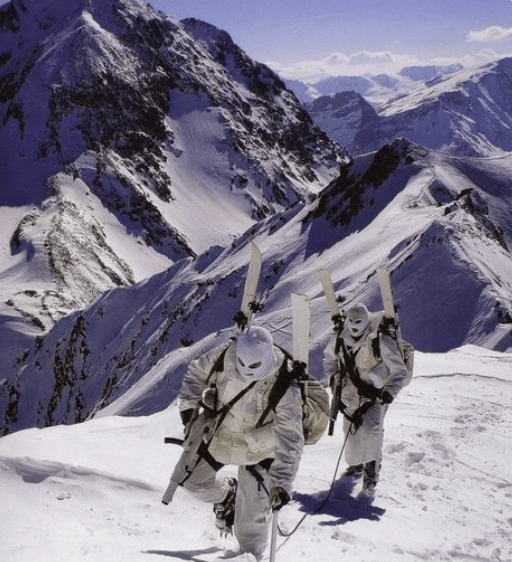
During one of these outings, crampons or not, I slipped and scraped my arm on the brutal ice. You must imagine not the smooth ice of an ice cube, but a vicious blend of gritty shards and snow. My forearm was shredded and bled profusely. I left my mark on the Vallée Blanche glacier, quite literally. The wound was bad enough to earn me a couple of rest days — a rare luxury.
One morning, several Puma helicopters landed near our camp. Section by section, dressed head-to-toe in white with skis strapped to the outside, we climbed aboard — no guns for once. They lifted us high up the mountain and hovered a few metres above a deep blanket of untouched snow. One by one we jumped out, plunging straight to our waists in soft powder. Climbing out of those holes and crawling toward the skis we had tossed out before jumping must have been quite a spectacle.
Once we were equipped, one of the greatest adventures of my life began: skiing down the Vallée Blanche. Even today, I often catch myself reminiscing about that extraordinary descent.
But as always, good things must end. Bandaged arm and all, I eventually climbed back into the trucks with the rest of the company. We bounced our way back to the barracks — or as we were officially meant to call it, le Quartier — in Annecy.
➿➿➿
Swimming across the lac
➿➿➿
Les parc nationaux
➿➿➿
The end is in sight
➿➿➿
Afterthoughts
➿➿➿
 sauvageraie.fr